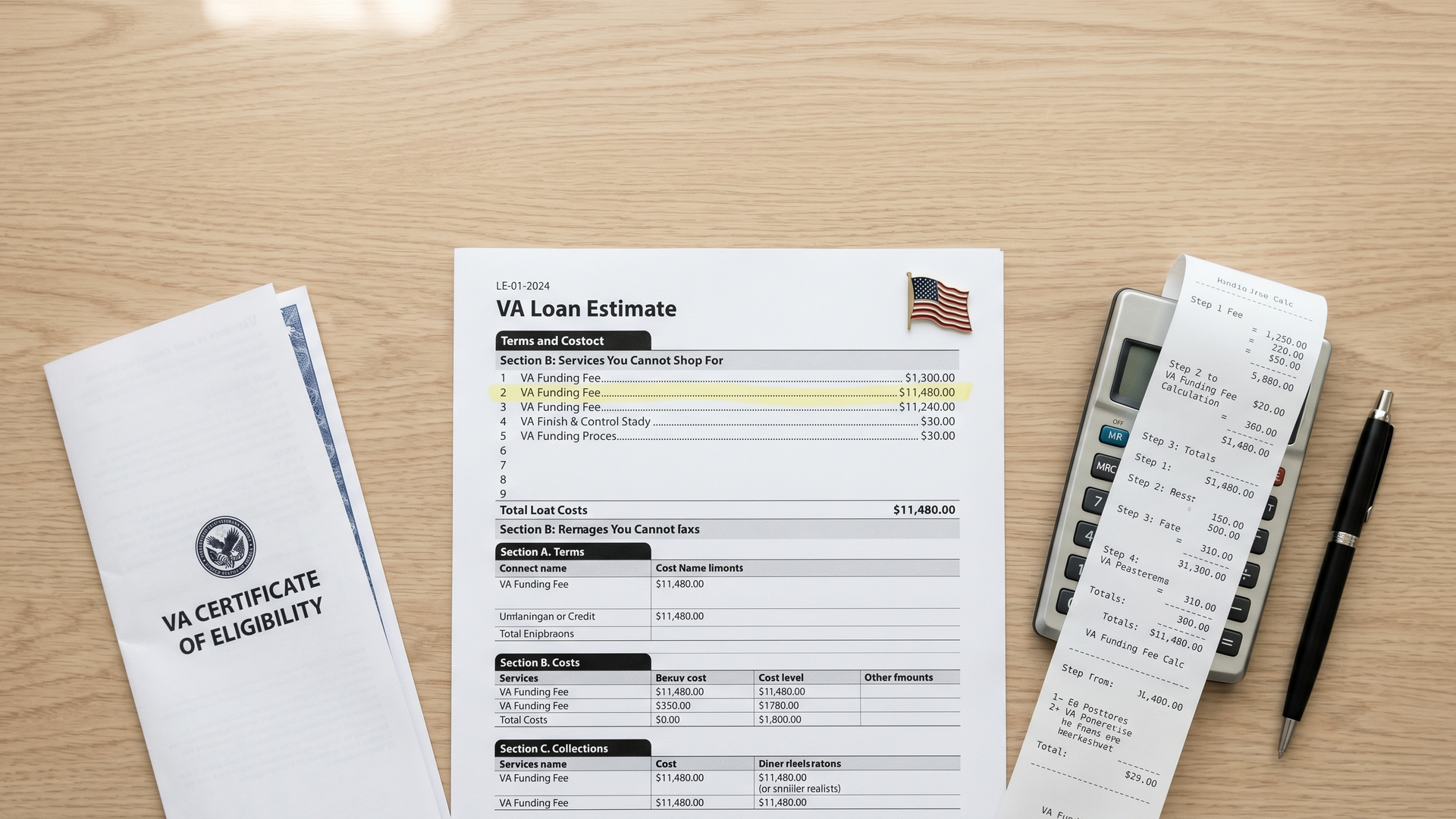
Most VA loan paperwork moves quickly, and most veterans coast through it because the program does so much of the heavy lifting up front. Then the funding fee shows up on the loan estimate, and the math suddenly feels less friendly. A 2.15 percent fee on a $400,000 loan is $8,600. On a subsequent-use loan with no down payment, the same purchase carries a 3.3 percent fee, which works out to $13,200. Those are real numbers, and the VA does not waive them just because you served. They exist for a specific reason, and your job at the closing table is deciding what to do about them.
The decision sounds small, but it changes the long-term cost of the loan in ways that are easy to underestimate. You can pay the funding fee in cash at closing, you can roll it into the loan balance, or you can avoid it entirely if you qualify for an exemption. None of those is automatically the right move. The right answer depends on your cash position, your service-connected disability status, the rate environment, and how long you plan to keep the loan. This article walks through what the fee is, what it costs in 2026, how to think about paying it upfront versus financing it, and the exemption rules that catch a lot of veterans by surprise. If you want a broader view first, the post on what most veterans miss about their VA home loan benefit is a useful pillar.
What Is the VA Funding Fee, and Why Does It Exist?
The funding fee is a one-time charge the Department of Veterans Affairs collects on most VA-backed loans. It is not collected by your lender as a service charge. It flows straight to the VA loan program and helps fund the guaranty that protects the lender if a veteran borrower defaults. That guaranty is what lets the VA loan program offer no-down-payment financing, no monthly mortgage insurance, and competitive interest rates without forcing the lender to absorb all of the credit risk. The funding fee keeps the program self-sustaining for the next generation of veterans, which is part of why the VA does not treat it as an optional charge.
That structure is also why the fee is the single most important thing to understand about your VA closing costs. It is usually the largest single line item on the loan estimate, and it is the only one with a percentage that swings dramatically based on how you use the benefit. Borrowers who treat it as a generic closing cost miss the levers that can lower it. Borrowers who understand it can sometimes save several thousand dollars on the same loan amount with the same lender, just by structuring the file differently. For a wider look at how government-backed mortgages compare to conventional financing, the trade-offs run in similar territory.
How the funding fee fits into your closing disclosure
On the loan estimate and the closing disclosure, the funding fee shows up under loan costs, separate from origination, appraisal, title, and recording. It is calculated as a percentage of the base loan amount, not the purchase price. If you finance the funding fee, the math runs in two passes: the lender calculates the fee on the base loan, then adds the fee to the loan, and the new total becomes your final loan amount. The percentage itself does not get applied a second time. That is a small but important detail when you are checking the numbers against a calculator estimate.
How Much Is the VA Funding Fee in 2026?
The VA publishes the current funding fee schedule on VA.gov. The percentages have been stable for several years and remain in effect for 2026. They split along three dimensions: whether this is your first VA loan or a subsequent use, how much you put down, and what type of transaction you are running. The numbers below are the standard tables for purchase, construction, and cash-out refinance loans. Streamline refinances and assumption transactions use different rates, covered separately below.
First-time use of your VA benefit
If this is your first VA loan, the funding fee runs 2.15 percent of the base loan amount with less than 5 percent down, 1.5 percent with 5 to 10 percent down, and 1.25 percent with 10 percent or more down. On a $400,000 loan with no down payment, that is $8,600 added to the file. On the same loan with 10 percent down, the fee drops to $5,000. Putting cash into a small down payment can lower the fee enough to almost fully recover the down payment in fee savings, which is one of the cleaner optimization moves available on a VA loan and one most buyers never consider.
Subsequent use of your VA benefit
If you have used a VA loan before and the entitlement is still in play, the no-down-payment fee jumps to 3.3 percent. With 5 to 10 percent down it drops back to 1.5 percent. With 10 percent or more down it drops to 1.25 percent. The 3.3 percent rate is the one that catches repeat users off guard. On a $400,000 subsequent-use loan with no down payment, the funding fee alone is $13,200. Many veterans assume the second loan should be cheaper because they already proved themselves on the first one, but the program is structured the other way: the second use signals more risk to the guaranty fund, and the fee reflects that.
Refinance fees, including the IRRRL
VA cash-out refinances follow the same 2.15 percent or 3.3 percent split based on first or subsequent use, regardless of the equity position. The Interest Rate Reduction Refinance Loan, or IRRRL, is the exception that pays off for many existing VA borrowers. The funding fee on an IRRRL is 0.5 percent flat, with no first-versus-subsequent-use distinction and no down-payment math. On a $400,000 streamline refinance, that is $2,000 in fee, often outweighed in the first year of monthly savings if the rate drop is meaningful. Veterans who already hold a VA loan and see rates drop sometimes hesitate because they expect the funding fee to recur at full price; the streamline path is specifically designed to avoid that.
Should You Pay the VA Funding Fee Upfront or Roll It Into the Loan?
This is the decision most veterans actually have to make at the closing table. The VA allows the funding fee to be paid in cash at closing or rolled into the loan balance. Both paths are common, both are legal, and both are offered on essentially every VA loan file. The right answer depends on three factors: how much cash you have available without drawing down your reserves, what your effective interest rate is on the rolled-in amount, and how long you expect to hold the loan.
The cash-flow tradeoff
If you have the cash to pay the fee at closing without raiding your emergency reserves or your moving budget, paying upfront avoids financing the fee at the loan rate for the next 30 years. That is the cleanest math. If paying upfront would leave you with no cushion in the first six months of homeownership, financing it is usually the safer call, even at the slightly higher long-term cost. Most loan officers will tell you the same thing, but it helps to have your own number for what reserve level you want to walk into the new house with.
The interest math on the rolled-in fee
Rolling the fee into the loan increases the loan balance, which increases the monthly payment and the total interest paid over the life of the loan. On a $400,000 first-use loan with no down payment at a 6.5 percent fixed rate, the $8,600 funding fee adds about $54 to the monthly payment. Over 30 years, that fee, financed at the loan rate, costs roughly $19,600 in principal and interest combined. Paying it in cash at closing avoids that interest entirely. If you plan to refinance or sell within five to seven years, the financed-fee interest cost is much smaller because you are not on the hook for the full 30-year arc. If you plan to stay in the loan for the long haul, paying upfront is usually the better long-term move when cash allows.
That math is not unique to VA loans. Borrowers running the same trade-off on conventional loans face it through the way PMI works for conventional borrowers, where a monthly insurance premium adds to the payment until the loan-to-value ratio falls below 80 percent. The funding fee is a one-time cost rather than a monthly one, but the underlying question of how to spread a program-required charge over time is the same.
What about asking the seller to cover it?
VA rules allow the seller to contribute up to 4 percent of the loan amount toward the buyer’s closing costs, and the funding fee counts inside that 4 percent cap. On a $400,000 loan, that ceiling is $16,000, which is enough to cover even a subsequent-use no-down funding fee with room to spare for other closing costs. In a buyer-friendly market, asking for a seller credit toward the funding fee is one of the most useful concessions a VA buyer can negotiate, because the seller does not care which line item the credit pays down. The buyer effectively avoids the fee out of pocket without rolling it into the loan.
Who Qualifies for a VA Funding Fee Exemption or Refund?
Some veterans owe nothing at all on the funding fee. The VA waives the fee entirely for borrowers receiving compensation for a service-connected disability, for veterans who would be entitled to compensation if they were not receiving retirement pay, and for surviving spouses of veterans who died in service or from a service-connected condition. Purple Heart recipients on active duty at the time of closing are also exempt. The exemption is not automatic in the lender’s pricing engine. The VA confirms eligibility through the Certificate of Eligibility, which the lender pulls during the loan application. If your COE shows the funding-fee exemption flag, the lender removes the fee from the loan estimate. If it does not show the flag and you believe you qualify, the fix usually starts with a request to the VA Regional Loan Center to update your COE before the closing disclosure is finalized.
Refunds when the disability rating arrives after closing
This is the situation that surprises the most veterans. If you closed on a VA loan and paid or financed the funding fee, then later received a service-connected disability rating with an effective date that pre-dates the loan closing, you are owed a refund of the funding fee. The refund process runs through the VA Regional Loan Center handling your loan, with documentation showing the disability rating, the effective date, and the closing date. Veterans who financed the fee can use the refund to pay down the loan principal directly. Veterans who paid in cash receive the refund themselves. This refund flow is one of the most overlooked benefits of the program, partly because the rating decisions and the closings rarely happen on a clean timeline. If your rating came through after closing, talk to your lender or the Regional Loan Center; do not assume the chance to recover the fee has passed. To compare what veterans pay against the broader pressure on mortgage closing costs across the market, the post on broader pressure on mortgage closing costs gives useful context.
Active-duty service members in transition
Active-duty service members who provide proof of having received the Purple Heart before closing can claim an exemption at the time of the loan, even before separation. Active-duty members not yet rated for a service-connected disability cannot claim the exemption upfront, but they retain the right to a refund later if the rating decision applies retroactively. If you are working with a Fellowship loan officer, ask early in the file to confirm your funding-fee status; on a long pre-approval timeline, a status change can happen in the middle of the process and meaningfully change your costs. To compare options across programs, the loan programs Fellowship offers veterans page lists the routes side by side.
How Should You Approach the Funding Fee Decision Before You Close?
The cleanest way to handle the funding fee is to settle it before you sign the rate-lock agreement, not at the closing table. By the time you are at the table, the loan is structured, the disclosures are issued, and changing course usually triggers a redisclosure and a delay. Three steps run well before that point: confirm your COE and check the funding-fee exemption flag, decide whether you are paying upfront or financing the fee based on a real cash-flow conversation with your loan officer, and run the seller-credit conversation early enough that it can be written into the offer rather than negotiated after acceptance.
That preparation also matters because the funding fee interacts with the rest of the loan structure. A lower loan amount can move you across the down-payment thresholds and reduce the fee percentage. A seller credit that covers part of the fee can free cash for points or reserves. A timing adjustment around a pending disability rating decision can save the fee entirely. None of those moves happen by accident; they happen because the borrower asked the question early and the loan officer was paying attention.
Frequently Asked Questions
How is the VA funding fee calculated?
The fee is a percentage of the base loan amount before the fee itself is added in. The percentage depends on whether this is your first VA loan or a subsequent use, how much you put down, and the loan type (purchase, cash-out refinance, IRRRL, construction, or assumption). For a first-use purchase with no down payment, the fee is 2.15 percent. With 5 to 10 percent down, it is 1.5 percent. With 10 percent or more down, it is 1.25 percent. Subsequent-use no-down loans carry a 3.3 percent fee.
Can the seller pay the VA funding fee for the buyer?
Yes. VA loan rules allow the seller to contribute up to 4 percent of the loan amount toward the buyer’s closing costs, and the funding fee counts inside that 4 percent ceiling. On a $400,000 loan, that is up to $16,000 the seller can apply. In a buyer-friendly market, this is one of the most useful concessions a VA buyer can negotiate.
Is the funding fee tax deductible?
The fee has historically been treated as a deductible mortgage insurance premium for taxpayers who itemize, but the deduction has expired and been reinstated multiple times by Congress. Whether it is deductible in any given tax year depends on the current state of the law and your filing situation. Confirm with a tax professional before relying on the deduction.
Do you pay the funding fee on every VA loan?
No. Veterans receiving compensation for a service-connected disability, surviving spouses of service members who died in service or from a service-connected condition, and Purple Heart recipients on active duty at closing are exempt from the fee. The exemption is verified through the Certificate of Eligibility issued by the VA. If your COE shows the exemption flag, your lender removes the fee from the loan estimate.
What happens to the VA funding fee if you refinance with an IRRRL?
The Interest Rate Reduction Refinance Loan carries a flat 0.5 percent funding fee, regardless of whether it is your first or subsequent use of the VA benefit. There is no down-payment math. On a $400,000 streamline refinance, that is $2,000, often recovered within the first year if the rate reduction is meaningful. Exempt veterans pay no funding fee on an IRRRL.
How do you request a VA funding fee refund after a disability rating?
If you closed on a VA loan, paid or financed the funding fee, and then received a service-connected disability rating with an effective date on or before the loan closing date, you are owed a refund. The refund is processed through the VA Regional Loan Center handling your loan, with documentation of the rating decision, the effective date, and the closing date. Borrowers who financed the fee typically apply the refund to the loan principal; borrowers who paid in cash receive the refund directly.
Is the VA funding fee the same as PMI?
No. PMI is a monthly insurance premium charged on conventional loans with less than 20 percent down. It continues until the loan-to-value ratio falls below 80 percent. The VA funding fee is a one-time charge collected at closing, never recurs, and replaces the need for monthly mortgage insurance entirely. The two costs serve a similar program purpose but differ in structure, timing, and total lifetime cost.
Talk Through Your VA Loan Numbers Before You Lock
The funding fee is one of the few line items on a mortgage where a thoughtful conversation before lock can save several thousand dollars without changing anything else about the file. If you are preparing to use your VA benefit, want a second look at the funding-fee math, or are not sure whether your COE reflects an exemption you may qualify for, the Fellowship Home Loans team can walk through the numbers with you and help you decide what fits your situation. Reach out before the lock conversation, not after, so the structure on your file matches the decision you actually want to make.